
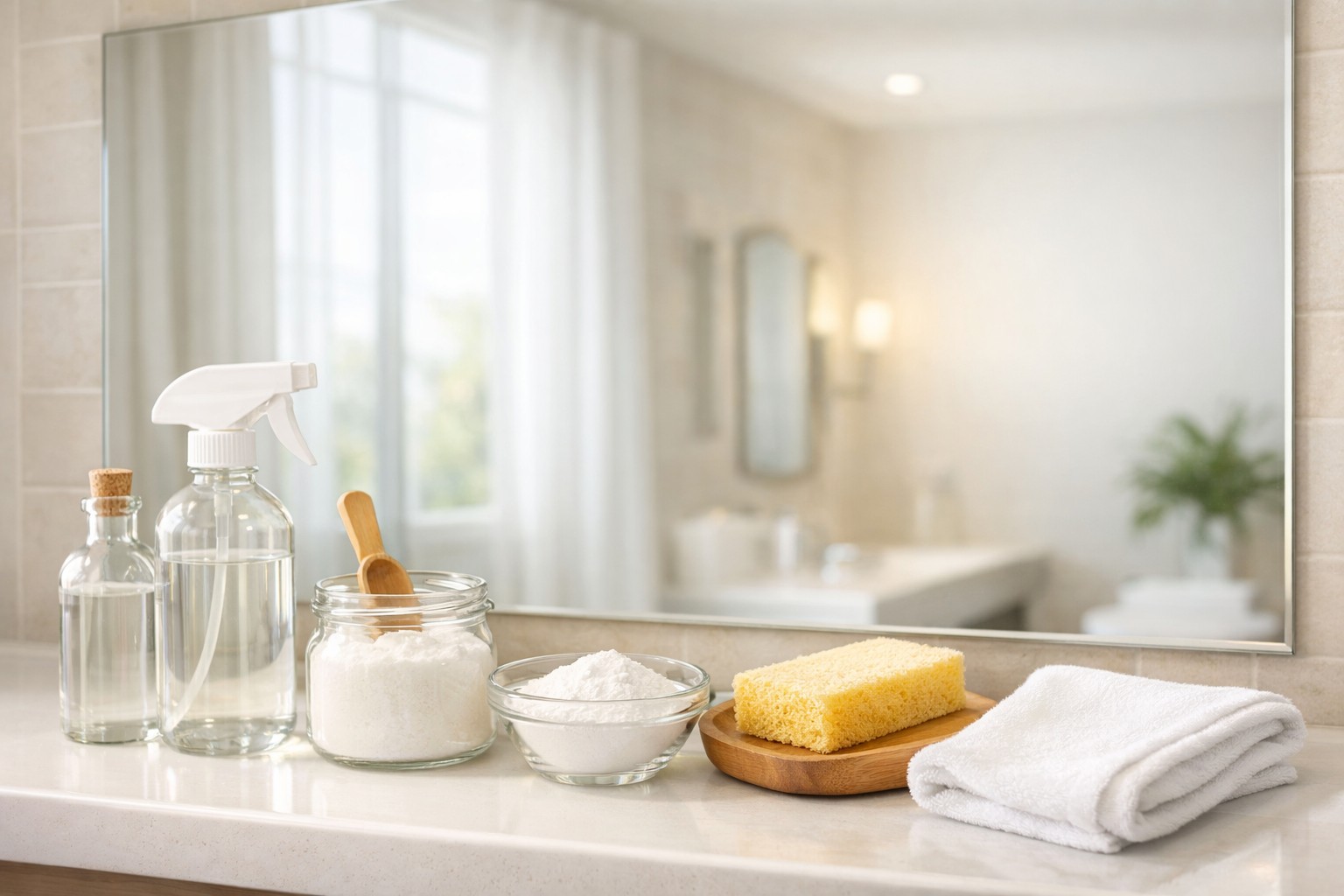
The mirror surface is the “face” of a cozy home, but it is on it most often remain annoying smudges и whitish streaks. Many housewives spend hours on polishing, not realizing that the reason for failure lies in the composition of cleaning agents or the wrong choice of fabric. To achieve crystal shineIt is important to understand the chemistry of the process and use proven methods that leave no residue.
Secret ingredients for shine
You don’t have to buy expensive household chemicals to remove stubborn dirt. Often the most effective ingredients are already at your fingertips:
-
Table vinegar. Mixed with water in a ratio of one to five, it is excellent at dissolving lime scale and greasy fingerprints.
-
Naphtha. This is the gold standard of professional cleaning. Adding just one tablespoon per liter of water allows for instant elimination of greasy film and give the glass its characteristic glow.
-
Strong tea infusion. The tannins it contains effectively fight dirt without the need for a long rinse.
Choosing the right tools
Even the best tool won’t work if you use the wrong rags. Normal terry towels leave lint, while poor quality paper towels can soak and turn into lint.
-
Microfiber with a smooth weave. It is the best choice for finish polishing as it absorbs moisture without leaving a microscopic streaks.
-
Old newspapers. A time-tested method: printing ink contains components that additionally polish the surface and protect it from rapid fogging.
-
Capron products. Old pantyhose are surprisingly effective in the final stage of cleaning, giving the glass a mirror-like smoothness.
A no-fault cleaning technique
The main mistake when washing mirrors is using too much water. When the liquid flows over the edges of the frame, it can damage the amalgam, causing black spots on the edges. It is best to apply the compound with a sprayer, moving from top to bottom in a zigzag motion. This avoids dripswhich, once dry, form new stains.
Special attention should be paid to the quality of water. If it is too hard in your region, calcium salts will remain on the mirror after drying. In this case it is better to use distilled water or add softening components. The right temperature also plays a role: warm water dissolves dirt faster, but hot water can lead to too rapid evaporation of the product, which makes it difficult to polish evenly.
Regular maintenance and the use of gentle cleaning compounds can help to preserve the clarity and depth of reflections in any interior for a long time.
About the Author