
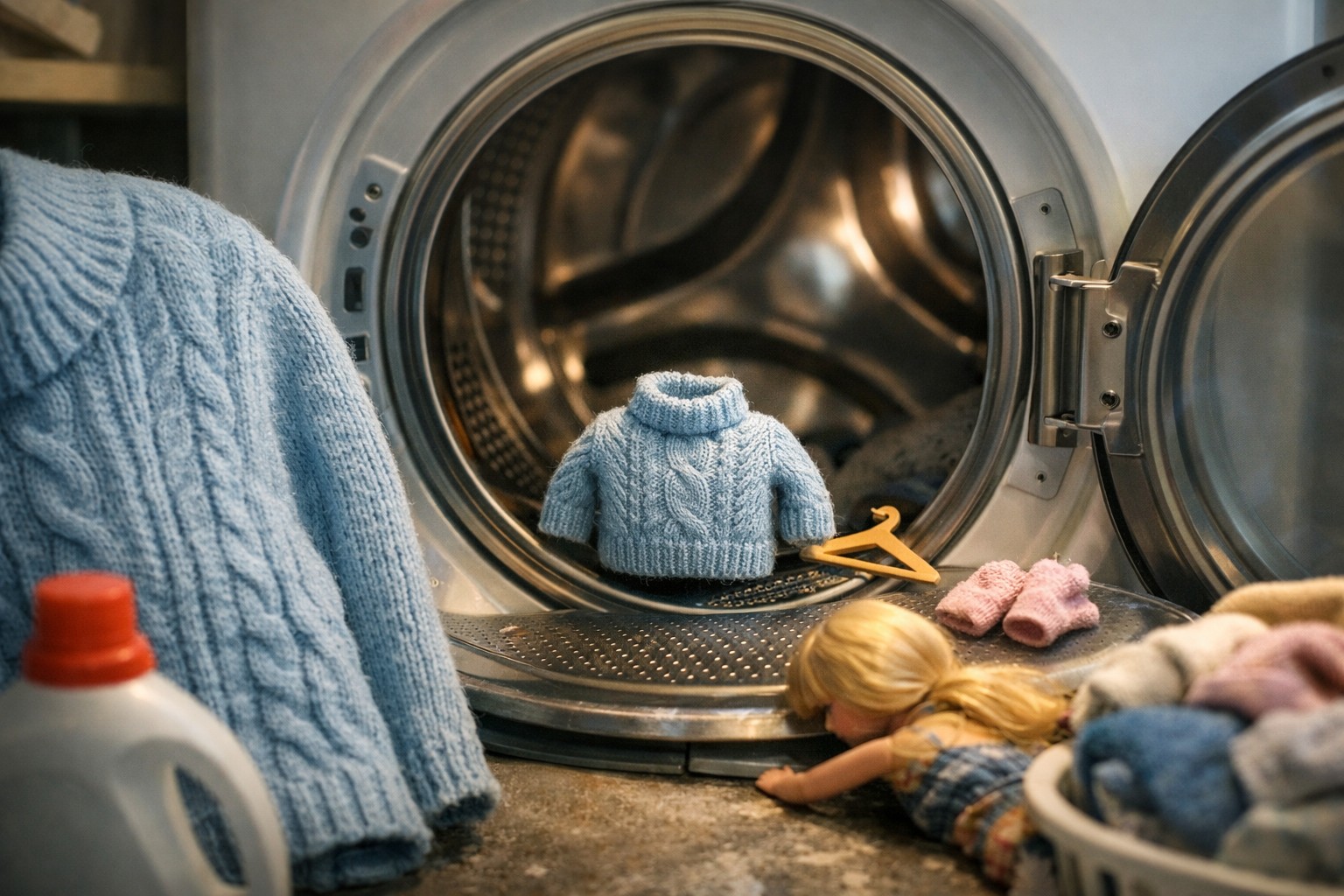
When a familiar item turns into cat clothes after washing, we often blame laundry detergent or “faulty” fabric. In reality, there is pure physics and biology behind the process and the biology of the fibers that respond to our attempts to make the clothes cleaner.
How the shrinkage mechanism works
The main reason for the metamorphosis lies in fiber relaxation. During the fabric production process, the yarns are subjected to extreme tension. They are literally forced to be longer and flatter than they actually are. As soon as the fabric is put into water, especially hot water, this tension disappears. The fibers “remember” their natural state and tend to return to their original, shorter shape.
The role of temperature and friction
High temperature acts as a catalyst. It softens the structure of the filaments, making them more amenable to deformation. However, temperature control is only half the problem.
-
Mechanical effectsThe intense rotation of the drum causes the lint to cling to each other.
-
Moisture absorption: natural fabrics (cotton, linen, wool) swell strongly with water, which changes the geometry of the weave of the threads.
-
Drying cycle: the hot air in the dryer finally fixes the fibers in a compressed state, completing the shrinking process.
Features of different materials
The most vulnerable are considered to be natural fabrics. Wool has a unique scaly structure similar to human hair. When exposed to hot water, these scales open up, and when rubbed together, they interlock to create a friction effect felt. It is an irreversible process in which the distance between fibers is reduced to a minimum.
Cotton and linen are also prone to size loss, but for a different reason. Their fibers are of vegetable origin and highly hygroscopic. When drying out after getting wet, they naturally shrink. Synthetic materials such as polyester or nylon are much more stable, as their yarns are artificially created and do not have a “memory” of tension to the same extent as natural raw materials.
Preventing size changes is helped by careful study of the label, which indicates the temperature limit and the preferred spin mode. The use of special conditioners reduces fiber friction, keeping the structure of the fabric in pristine condition for years to come. Any item will last longer if the basic rules of care for a particular type of textile are followed.
About the Author