
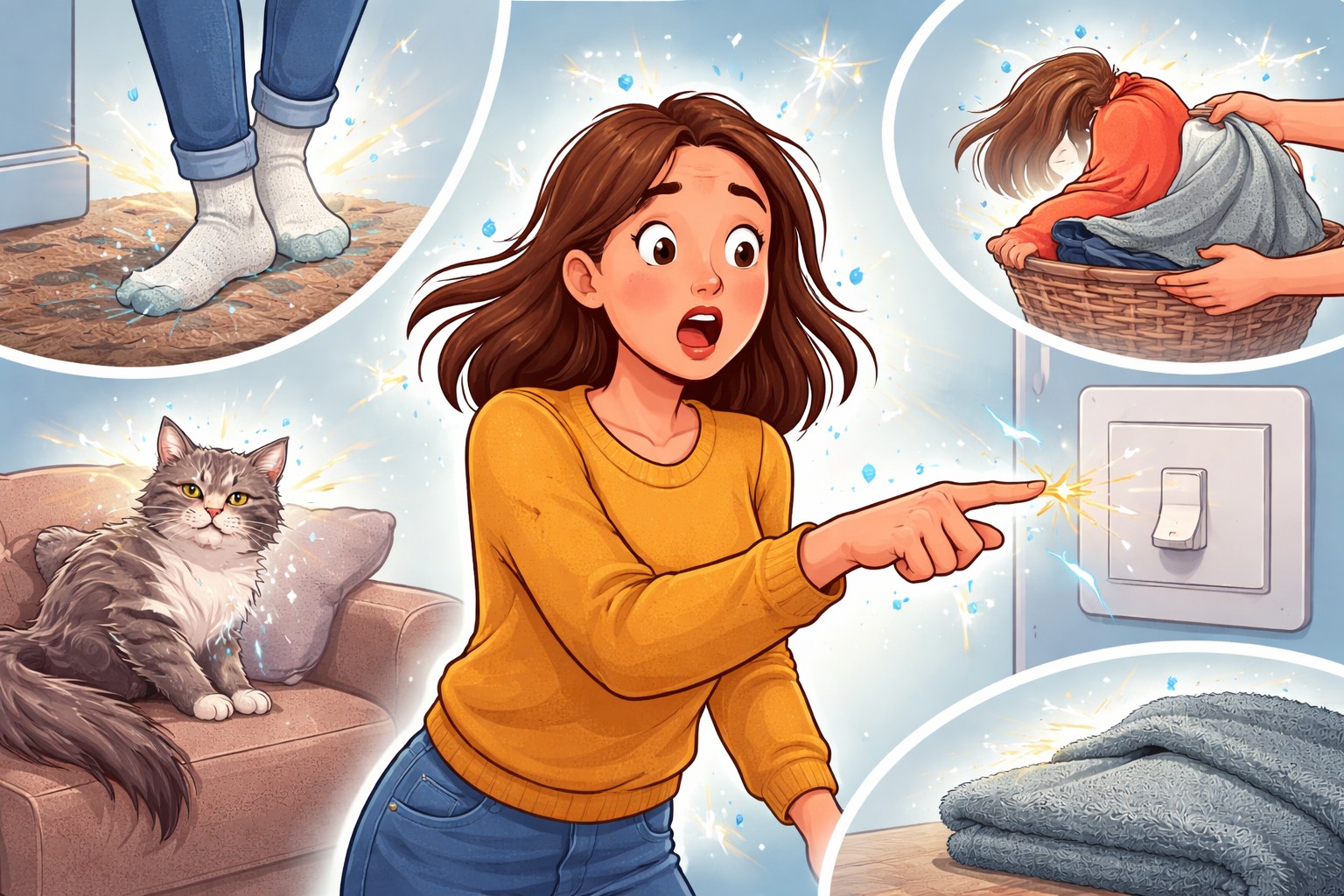
Static electricity is a phenomenon that each of us encounters in everyday life. You take off your sweater, touch a door handle, or get out of the car, and suddenly feel a sharp, unpleasant sensation. electric shock. This is not magic or a wiring fault, but a fundamental physical process related to behavior elementary particles.
The nature of the charge
At the core of everything are atomsconsisting of a positively charged nucleus and negative ones rotating around it electrons. In the normal state, the number of charges is balanced, and the object remains neutral. However, when two different materials come into contact, electron redistribution.
One material “gives up” particles, acquiring a positive charge, and the other “takes” them, becoming negatively charged. This process is called triboelectric effect. When you separate these surfaces (for example, by removing clothing), the accumulated charge cannot immediately return to its place, creating potential difference.
The main reasons for the accumulation of static
There are several key factors that contribute to your becoming a “living battery”:
-
Dry air. Water is an excellent conductor. If air humidity is high, static charge constantly “drains” from surfaces through microscopic drops of water. During the heating season, indoor air becomes dry, which blocks this leakage path and allows the charge to accumulate to enormous levels.
-
Synthetic materials. Natural fabrics such as cotton retain moisture better and are less prone to static buildup. At the same time, polyester, nylon and acrylic exchange electrons extremely actively, becoming the main sources of sparks.
-
Surface friction. Walking on a carpet in rubber shoes or rubbing plastic parts against each other creates ideal conditions for the separation of charges.
-
Individual skin characteristics. Dry skin conducts electricity less well, allowing the charge to linger on the surface of the body instead of smoothly dissipating into the environment.
How physics explains electric shock
That very unpleasant click occurs at the moment electrostatic discharge. When the potential accumulated on your body reaches a critical level, and you bring your finger closer to a grounded metal object, the air between them ionizes. In this short moment, a breakdown occurs, and the accumulated energy rushes into the metal, creating a visible spark and a characteristic sound.
Interestingly, the voltage during such a discharge can reach several thousand volts. However, the current strength remains negligibly small, so static electricity in everyday life usually does not pose a danger to human health, although it can damage sensitive microelectronics.
Humidifiers, the use of antistatic agents, and the choice of clothing made from natural fibers can help reduce the intensity of these phenomena. Understanding the mechanisms of movement of charged particles allows you to effectively manage comfort in your space and avoid sudden electrical discharges.
About the Author