You just wiped down the shelves, and after a couple of days they again have a gray coating on them. It seems that household dust materializes out of nowhere, but in fact it is a complex “cocktail” of organic and mineral particles that enter the house in different ways. Understanding the composition of these contaminants helps to more effectively maintain cleanliness and preserve respiratory health.
Main sources of pollution
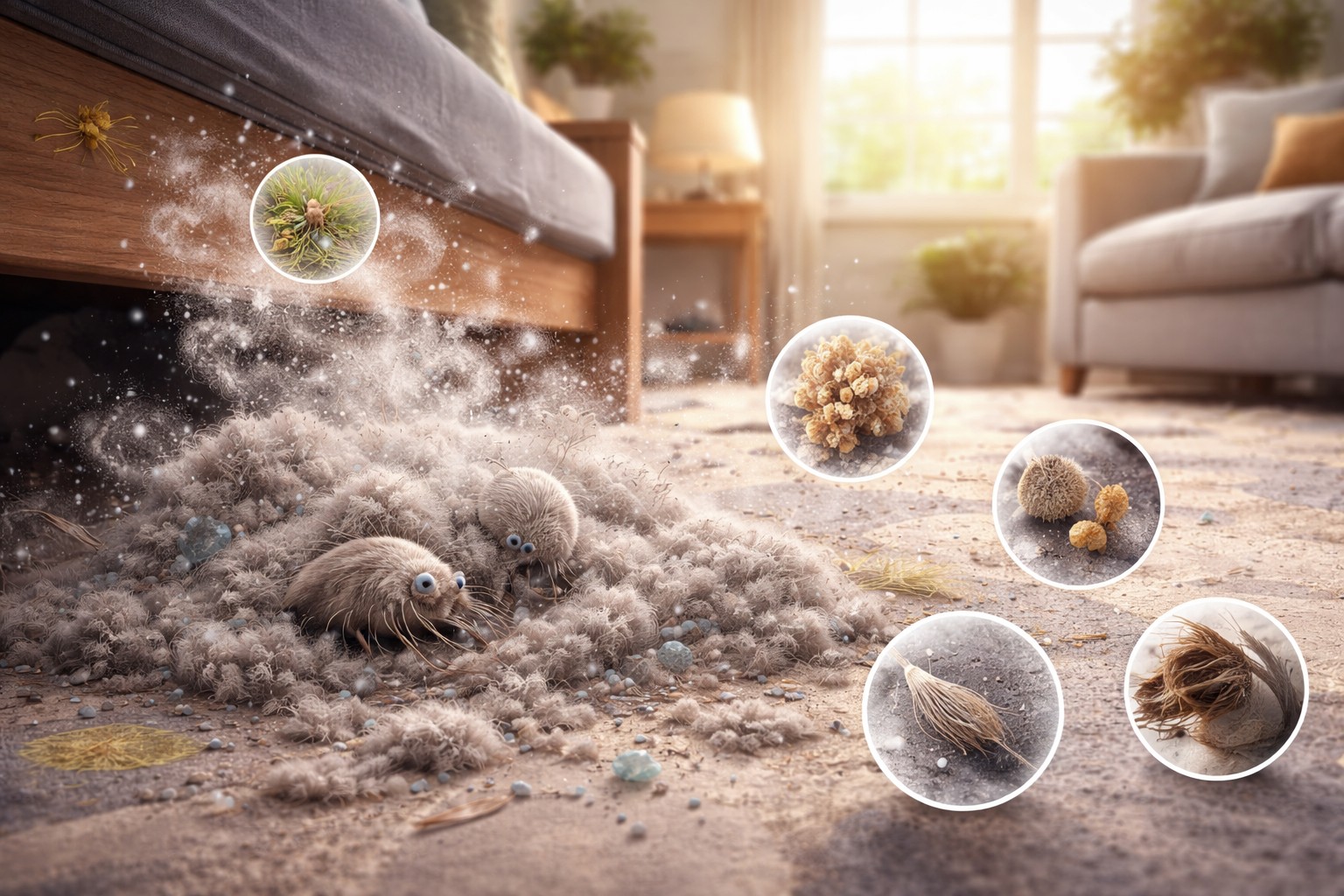
Most of what we call dust is generated within the building itself. The main “suppliers” of garbage are the inhabitants of the house themselves and the interior items:
-
Dead skin particles. Every day a person loses millions of microscopic epithelial scales, which become the main basis for the formation of dust accumulations.
-
Textile fibers. Bed linen, towels, clothes and carpets are constantly destroyed by friction, throwing lint into the air that is invisible to the eye.
-
Pet hair. Even if the pet does not actively shed, its undercoat and epidermal particles make a significant contribution to the total amount of pollution.
-
Insect waste products. Microscopic dust miteswhich feed on skin flakes, leave traces that can cause allergic reactions.
Why does dust accumulate in certain places?
Have you noticed that there is always more dirt on the TV or behind the closet? This is explained by the laws of physics and the characteristics of air circulation.
Static electricity plays a key role in attracting particles. Operating household appliances and synthetic surfaces create an electromagnetic field that literally “magnetizes” suspended matter from the air. This is why monitors and rear instrument panels become coated the fastest.
Convection currents transport small particles throughout the apartment. Warm air from the radiators raises dust, and in areas with poor ventilation or in corners where air movement slows down, it settles in a dense layer. Hard to reach places behind the furniture they become a kind of trap, where scales and fibers are woven into full-fledged flakes under the influence of humidity.
External factors and microclimate
Don’t forget about what comes into the house from the outside. About a third of the composition of house dust is mineral particlescarried on the soles of shoes or pulled through an open window. Soot from cars, pollen and soil particles mix with household waste, making it heavier.
Level air humidity directly affects how long dirt remains in the air. In a dry room, particles do not settle for a long time, entering the lungs with every breath. With optimal humidity, they quickly become heavy and sink to the surface, from where they are much easier to remove with a damp cloth.
Regular wet cleaning and the use of air purifiers can significantly reduce the concentration of harmful particles in the living space.
About the Author