
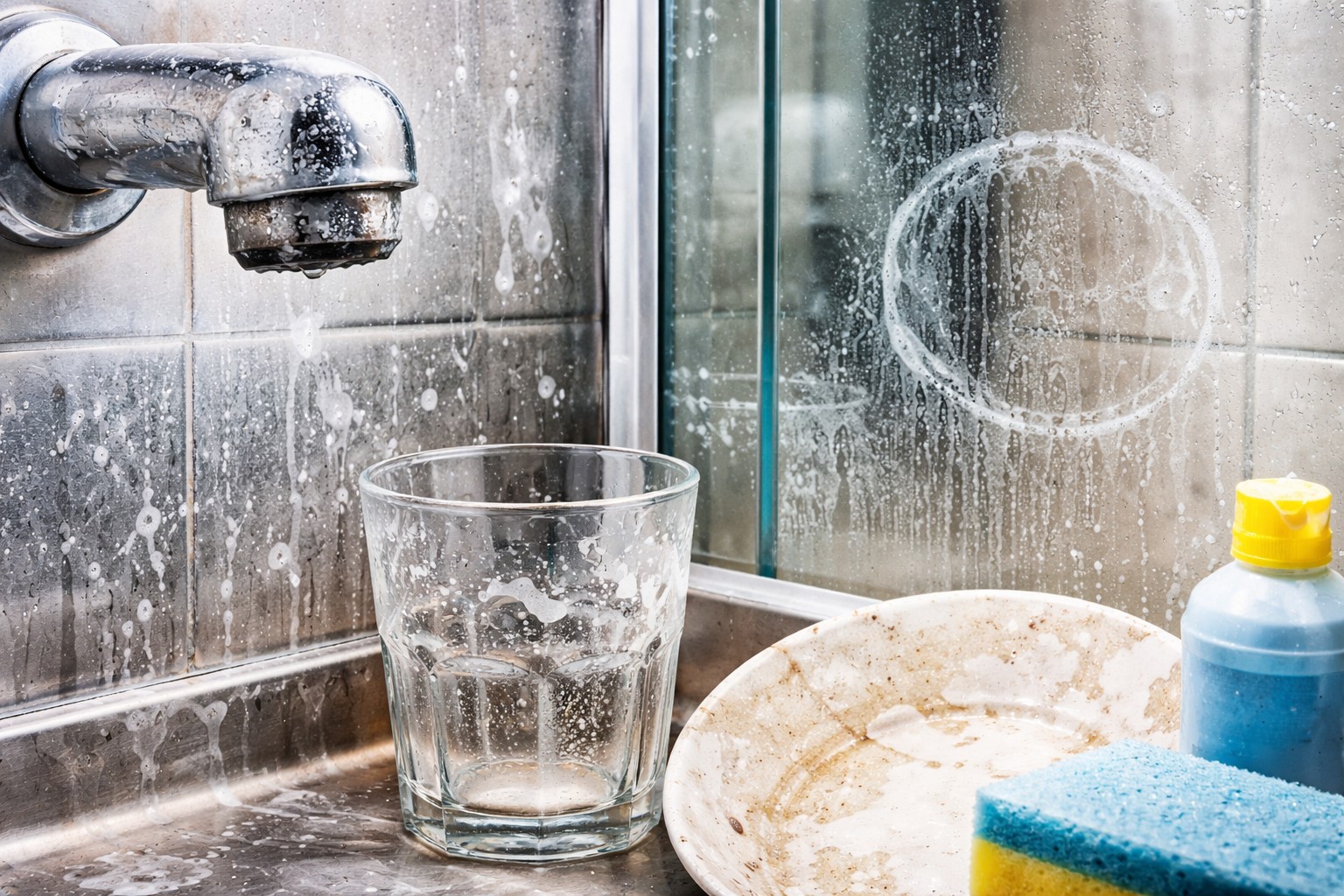
Many have noticed that even after thorough cleaning, stains remain on glass, taps or dishes. whitish spots and muddy tracks. It seems that seemingly clean water should evaporate without a trace, but the physics and chemistry of the process dictate their own rules. The main reason lies in the composition of the liquid that flows from our taps.
The secret lies in the so-called dry residue. When a drop of water touches a surface and begins to evaporate, the molecules transform into a gaseous state and escape into the atmosphere. However, all substances dissolved in it cannot evaporate along with the steam. They become concentrated in the droplet debris and eventually settle on the surface as solid deposits.
Composition of invisible impurities
Most traces leave very specific components that are always present in tap or natural water:
. Mineral salts. First of all, these are calcium and magnesium salts. They are the ones responsible for water hardness. When the water dries, these minerals crystallize, forming a hard limescale deposit that is especially noticeable on dark surfaces and chrome faucets. . Organic compounds. The water may contain microscopic particles of humic substances, bacteria or algae residues, which, when dried, create a sticky film or dark edges of the stain. . Corrosion products. If the pipes in the house are old, particles of oxidized iron enter the water. In this case, the marks after drying may have a characteristic reddish or yellow tint. . Chlorides and sulfates. These chemicals are added for disinfection or enter the water from the soil, also contributing to the formation of visible sediment.
Coffee stain effect
Interestingly, contaminants are often distributed unevenly, forming a pronounced ring around the edges of the drop. This phenomenon is scientifically called coffee stain effect. During the evaporation process, liquid leaves the edges of the drop faster, which causes internal flow from the center to the periphery. This current carries all suspended particles to the edges, where they become fixed, creating a clear outline.
Even visually clear water is a complex solution containing dozens of different elements and compounds. The intensity of the traces left directly depends on the level of mineralization and purity of the liquid used. Reverse osmosis filters, which almost completely remove dissolved impuritiespreventing the appearance of plaque.
The transparency of liquid water does not guarantee the absence of solids, which inevitably appear after the evaporation process is completed.
Understanding the mechanisms of sediment formation helps you choose the right methods for cleaning and protecting household surfaces from stubborn stains.
About the Author