
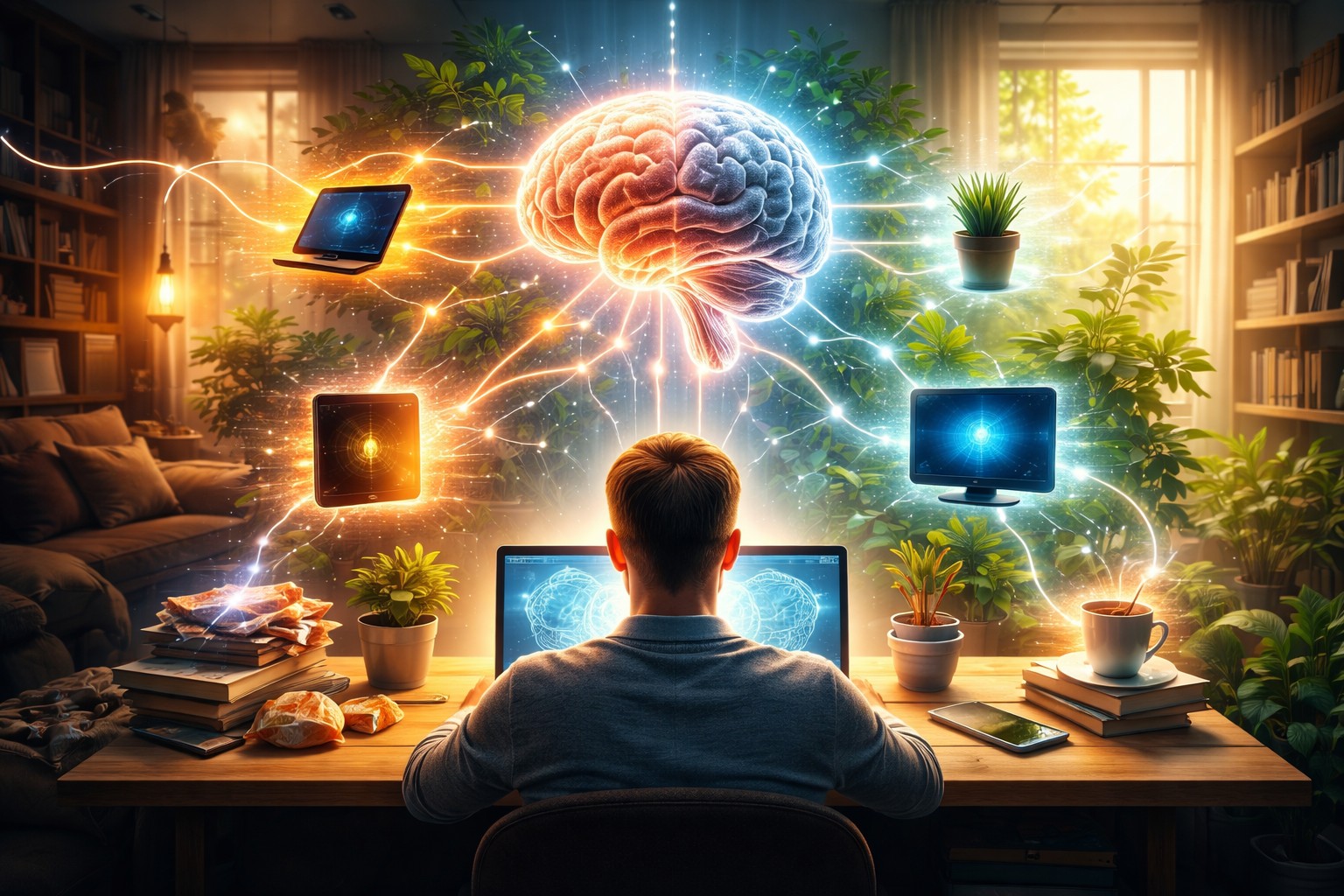
We are used to thinking that our thoughts, mood and productivity depend solely on internal efforts or character. However, neuroscience tells us otherwise: what we see and hear every day literally shapes the architecture of our neural connections. The environment is not just a background for life, but an active participant in our mental processes.
Visual noise and anxiety level
A cluttered room often leads to a cluttered mind, and there is a scientific explanation for this. An environment oversaturated with details creates sensory overload. When the eye is constantly confronted with scattered items, brightly colored labels, or cluttered furniture, the brain is forced to expend energy processing these visual stimuli, even if we are not paying conscious attention to them.
This condition keeps the psyche in tension and provokes the release cortisol – stress hormone. Research shows that people who live in cluttered spaces are more likely to suffer from procrastination and have difficulty concentrating. Minimalism in the interior, on the contrary, reduces cognitive load, allowing the brain to rest.
Geometry of space and thinking
The architecture of a room can dictate our way of thinking. The height of the ceilings, for example, directly affects cognitive strategies. High ceilings activate areas of the brain responsible for abstract and creative thinking, stimulating a sense of freedom. Low ceilings, on the contrary, promote concentration on details and performing routine, specific tasks.
The shape of objects is also important. Sharp corners are subconsciously perceived by our limbic system as a potential threat, which keeps the body in a slight tone. Smooth, rounded lines of the interior are associated with safety and promote relaxation.
The influence of lighting on biorhythms
Light is the main regulator of our circadian rhythms. Natural sunlight stimulates the production of serotonin, improving mood and alertness. However, artificial light, especially cool blue light from screens and lamps, can throw off your body clock.
Too much blue light in the evening blocks production melatoninsleep hormone. This not only leads to insomnia, but also increases the risk of developing depression. Competent management of light scenarios in the home helps stabilize the emotional background without medication.
Mirror neuron effect
The social environment affects us just as much as the physical environment. Our brain is equipped with a system mirror neuronswhich are responsible for empathy and imitation. We unconsciously adopt the behavioral patterns, intonations, and even stress levels of those people with whom we spend the most time.
If your environment constantly broadcasts anxiety or pessimism, your psyche will begin to mirror this state, perceiving it as the norm. This phenomenon is called emotional contagion. Filtering your social circle and information field is a necessary condition for maintaining mental stability.
The psyche has the property of neuroplasticity – the ability to change under the influence of experience. This means that we are not hostages of our environment, but its architects. By changing lighting, removing visual noise, or choosing a supportive environment, we physically rewire our brains and improve our quality of life.
About the Author