
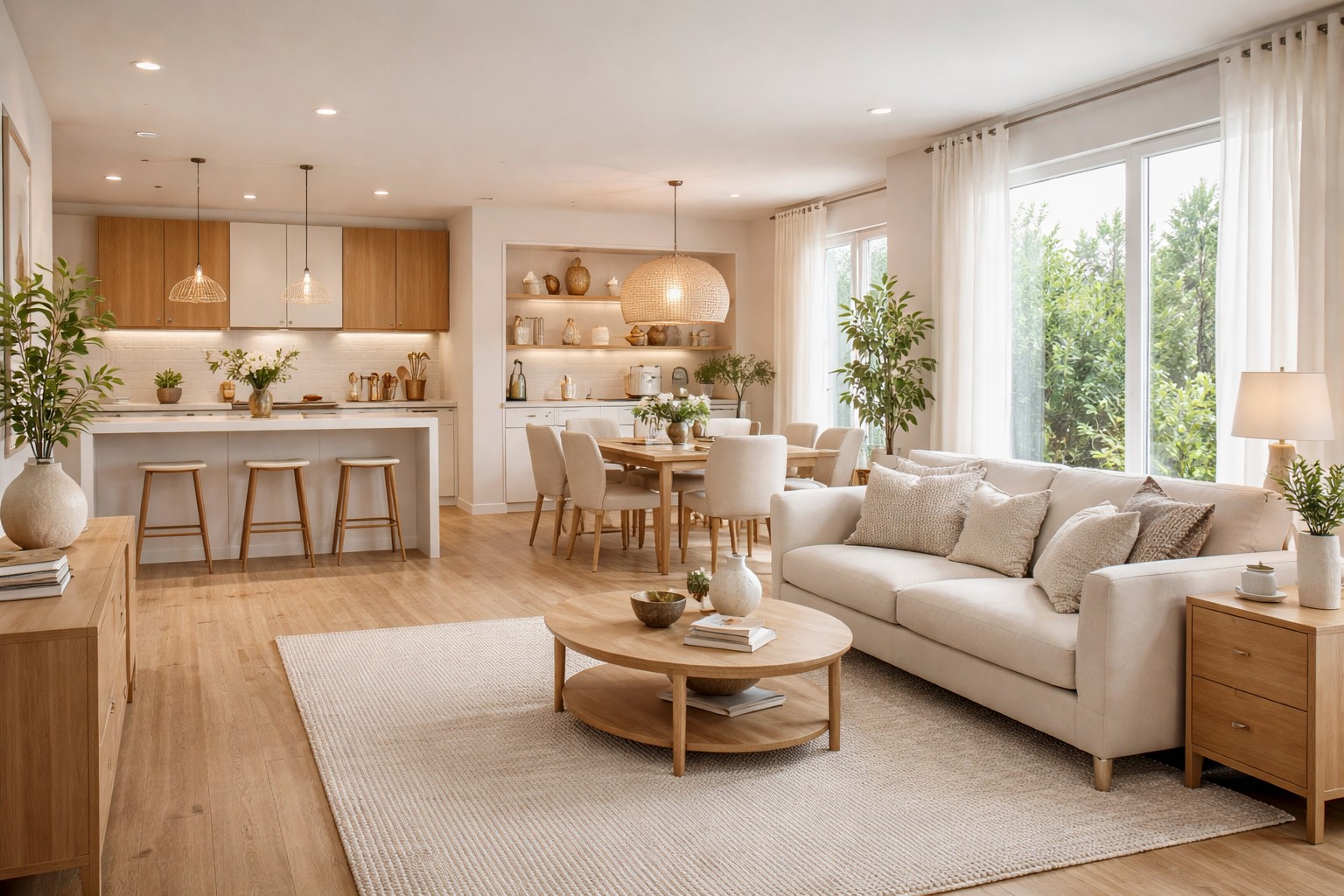
Many people mistakenly believe that dividing space into zones is only necessary for owners of tiny studios or huge lofts. Actually smart zoning – this is not about building plasterboard walls, but about managing attention and creating invisible boundaries that change the feeling of your home. This is a tool that allows you to customize your apartment to suit your rhythm of life, even if it only has one room.
Psychological relief and the fight against insomnia
Our brain works on the basis of stable associations. If you work, eat and watch TV shows while sitting on the bed, the body stops perceiving the sleeping place as a zone for recuperation. The result is sleep problems and a constant feeling of anxiety.
Dividing the house into functional areas helps to build clear neural connections:
-
A soft corner or armchair is recreation area;
-
A desk is a space for concentration;
-
The bed is a place exclusively for sleeping.
This distinction allows you to switch between “work” and “relax” modes automatically, simply by moving from one part of the room to another.
Visual expansion of space
Paradoxically, an open, empty space often seems less cozy and functional than a room divided into logical sections. Zoning adds to the interior depth and complexity. Instead of one “flat” picture, the eye reads several plans, which visually increases the volume of the room.
To do this, it is not necessary to use bulky cabinets. Great tools include:
-
Light scenarios (different light temperatures for different zones);
-
Floor coverings and carpets;
-
Various textures in wall decoration;
-
Light shelving or live plants.
Localization of disorder
One of the main household advantages of zoning is simplified cleaning. When every thing has its own clear functional areathe mess stops “spreading” throughout the apartment. Chaos is localized to a specific point where activity occurs and is much easier to eliminate.
For example, if the children’s play area is separated from the living room by a podium or carpet color, toys are less likely to end up on the dining table. It creates a feeling permanent order throughout the rest of the house, even if one area is currently bustling with activity.
Personal space for everyone
In conditions where several people live in an apartment, the absence of zones turns life into a constant intersection of trajectories. Smart planning creates islands privacy. Even a symbolic fence in the form of a screen or a high back of a sofa gives a person a feeling of security and privacy.
This is critically important for maintaining a healthy microclimate in the family. The ability to “hide” in your corner with a book or laptop without leaving the common room reduces stress levels and prevents domestic conflicts.
Organizing space into zones turns square meters into a smart system that works for your comfort. A properly built interior itself suggests behavioral scenarios, helps you relax faster and work more efficiently, without requiring major repairs or remodeling of walls.
About the Author