
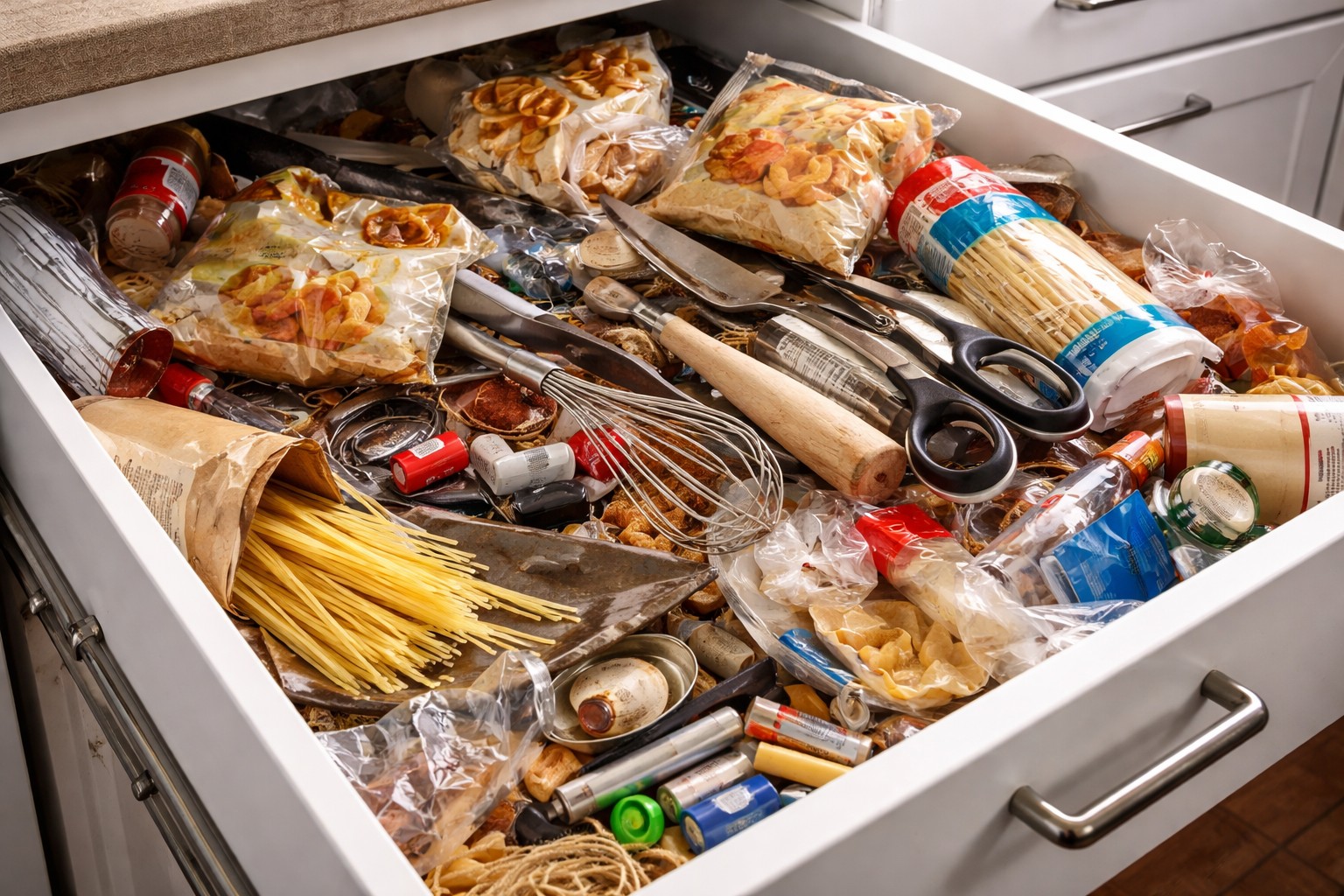
Even after general cleaning, the ideal appearance of the inside of a chest of drawers or desktop does not last long. After just a week, the socks get mixed up, the office supplies fall apart, and the little things you need disappear into the background. The problem often lies not in the lack of discipline, but in improper organization of space. If the storage system is inconvenient, the brain automatically chooses the path of least resistance by simply throwing things into a pile.
The habit of putting things in piles is one of the most common mistakes. When things lie on top of each other, in order to get the bottom one, you have to break the entire structure. It is much more efficient to use vertical storage. In this case, each item is visible immediately, and its removal does not affect its neighbors. This works for clothes as well as kitchen towels or documents.
Another reason for chaos is the lack of clear boundaries. A spacious drawer without dividers inevitably turns into a landfill. Small objects begin to “migrate” when opening and closing, creating visual noise. Usage organizers or simple boxes fixes things in their places. Each category should have its own strictly limited space, beyond which it does not go.
We often store things we don’t use in drawers when creating lack of space. When a space is packed to capacity, it is physically impossible to maintain order—there is simply nowhere for things to return. The “air” rule states that any compartment should be filled to a maximum of 80%. The remaining 20% of free space allows you to easily maneuver items and put them back without effort.
It is important to consider categorization of objects. If batteries, threads, and receipts are in one compartment, the brain stops perceiving this place as a system. Mixing heterogeneous categories blurs the logic of storage. It is much more practical to allocate separate zones for each group of things, even if there are very few of them.
Order is not based on willpower, but on the ease of use of the created system. The organization of space should be such that putting a thing in its place is easier than throwing it anywhere. Properly configured storage works on its own and saves time.
About the Author