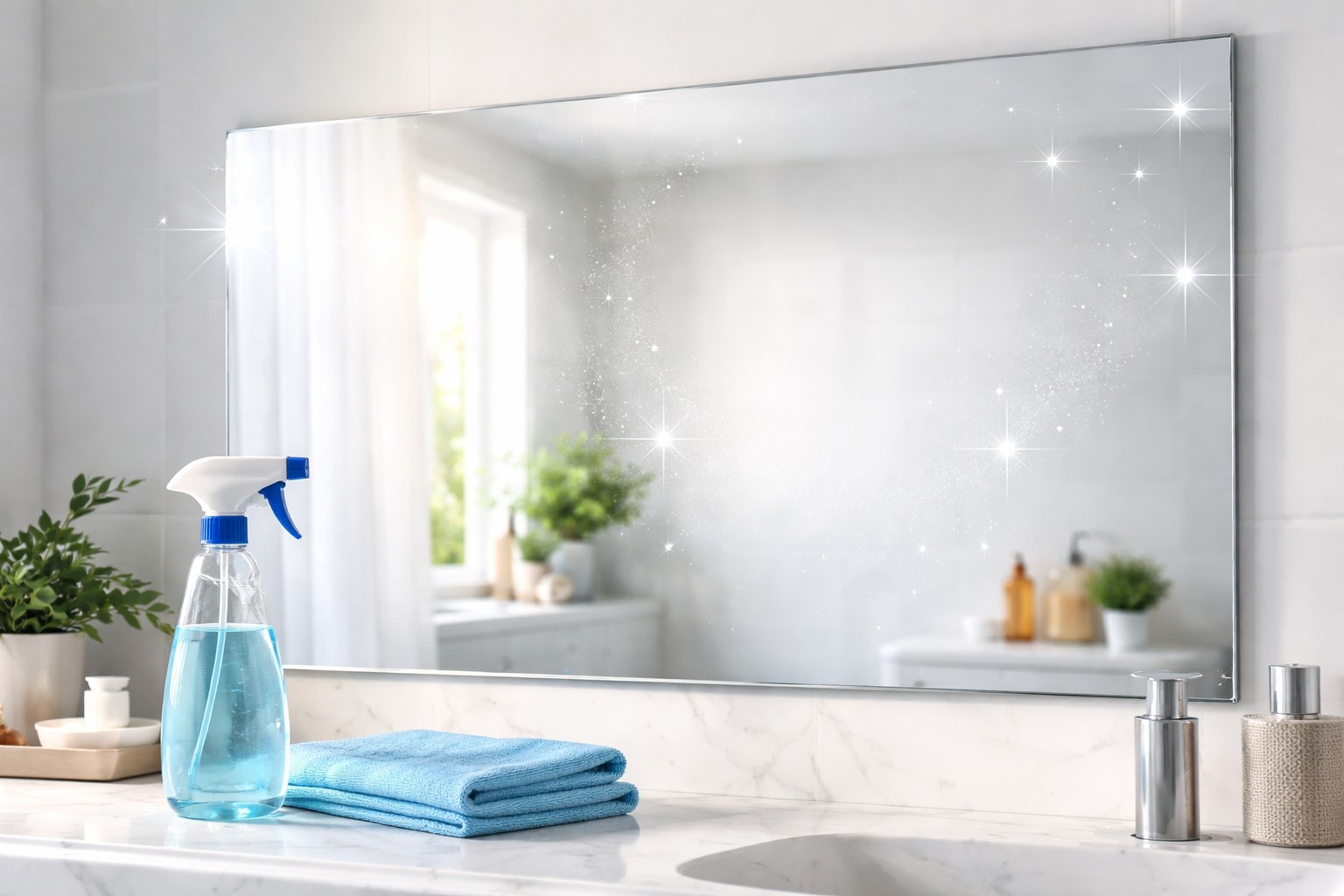
Every cleaning turns into a challenge when telltale stripes appear on the mirror again and again. Often the reason lies not in a lack of effort, but in incorrectly selected means and equipment. Perfect transparency accessible to everyone if you know a few simple secrets that cleaning professionals use.
Why do divorces occur?
The main enemy of a clean mirror is detergent residue. If you use a soap solution or all-purpose spray, the particles will harden on the glass, forming a cloudy film. Another common mistake is using fabrics with pile or low quality paper towels. They leave microscopic fibers, which, when you try to remove them, only smear the dirt.
The right tool
Forget about old T-shirts and newspapers. Microfiber – the best material for working with glass surfaces. You will need two napkins:
The special texture of microfiber “captures” dust and grease, holding them inside the fibers rather than spreading them across the surface.
Homemade solution or chemistry
You don’t have to buy expensive products. Ordinary table vinegarmixed with water in a 1:1 ratio, works wonders. The acid effectively dissolves greasy deposits and lime deposits, evaporating instantly and leaving no traces. If the smell of vinegar is unpleasant to you, you can add a couple of drops of lemon essential oil. Store-bought glass cleaners also work, but it’s important don’t overdo it with quantity: excess liquid is more difficult to polish.
Movement technique
Chaotic circular movements often lead to the appearance of static electricity, which attracts dust back. Try wiping the mirror S-shaped movements top down. This allows you to drive away dirt without returning to already cleaned areas. Start from the top corner and smoothly work your way down to the bottom, controlling the pressure.
The final touch is to examine the surface from a different angle. If you notice a small stain, remove it with a dry microfiber piece using a point-to-point touch. Now your mirror is not just clean, but truly invisible, adding light and space to the room.
About the Author