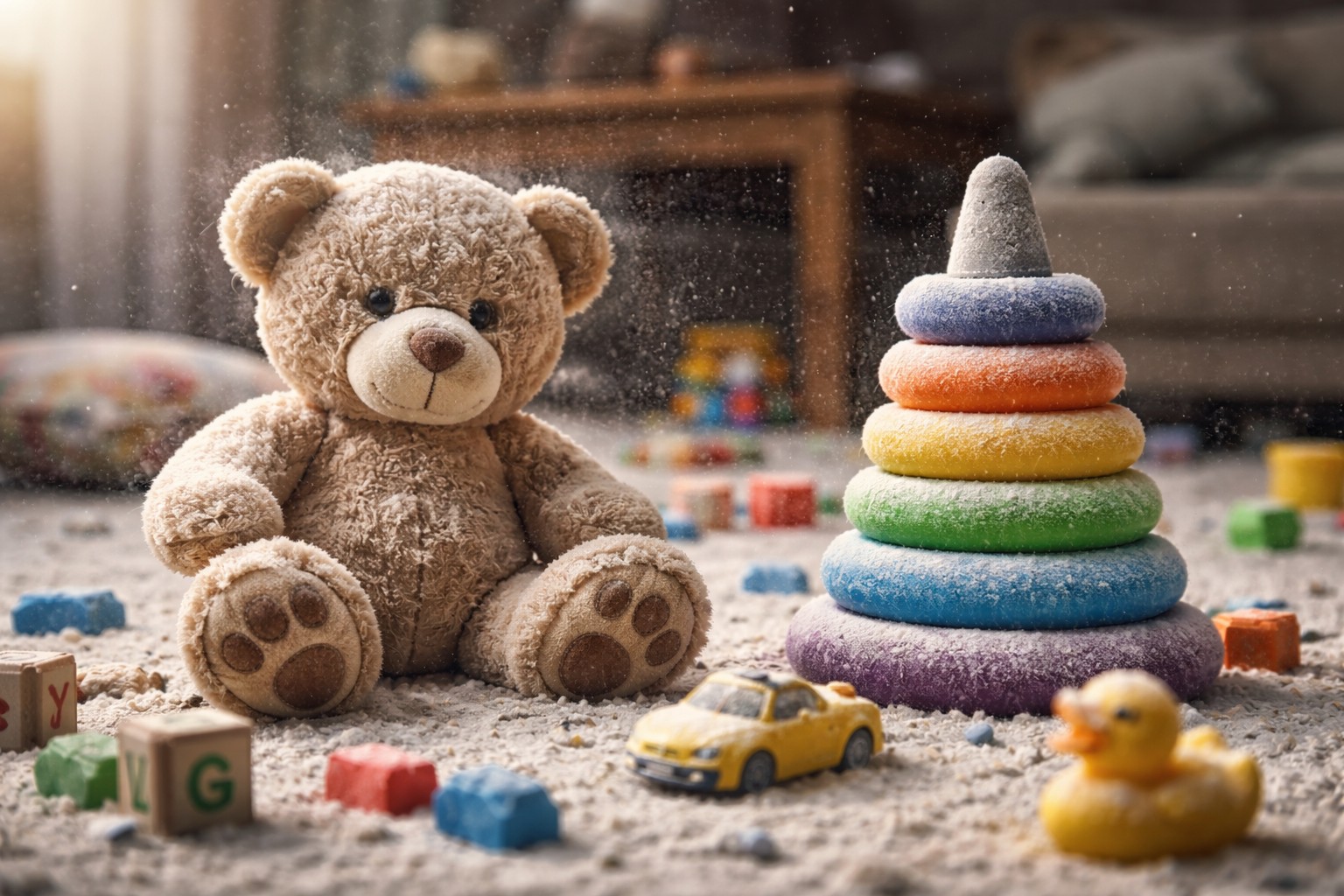
Even with regular cleaning, many people notice that collections of dolls, cars and teddy bears become covered with a gray coating faster than bookshelves. This does not happen by chance, but due to the special properties of materials and physical laws that turn harmless objects into real ones. dust collectors. Understanding the reasons will help you keep your room clean without any extra effort.
Effect of static electricity
The main reason why toys actively collect pollution lies in the materials. Most modern products are made from synthetic fiberspolyester or plastic. These materials have the property of accumulating static charge at the slightest friction with air or other objects.
An electrified surface acts like a magnet. It literally pulls dust microparticles out of the air and holds them on itself. Unlike wooden furniture or natural fabrics, synthetics do not allow dust to simply settle nearby, but forcefully fixes it on the surface of the toy.
Features of texture and volume
Soft toys have a complex structure. Thick pile, plush or faux fur multiplies surface area. If you unfold all the fibers of one medium-sized bear, the area of contact with air will be enormous.
Dust gets stuck deep in the fibers, where it is difficult to notice immediately. The dense padding inside also encourages the accumulation of small particles that penetrate the fabric. Over time, the toy becomes heavier due to contaminants hidden inside, even if it looks relatively clean on the outside.
Location and lack of traffic
Toys are often stored on open shelves or sit in the corner of a room without movement for weeks. On items that we constantly use (for example, pillows or blankets), dust does not have time to accumulate in large quantities, as it is constantly shaken off during use.
Stationary objects, especially those standing on lower tiers or floor, are in the zone of maximum concentration of dust particles. Here the air circulation is weaker and subsidence occurs more intensely.
How to minimize the problem
It is impossible to completely get rid of dust, but you can reduce its amount. Experts recommend storing unused collections in closed containers or boxes. This creates a physical barrier for settling particles.
For soft items, periodic washing at a temperature allowed by the manufacturer or using a vacuum cleaner with a special attachment is useful. Regular care of textiles and plastics makes the air in the children’s room much cleaner and safer to breathe.
About the Author