Even with frequent cleaning, many people notice that textile flooring gets dirty faster than laminate or tile. This happens for a reason: a carpet is a complex engineering device that works as powerful filter.
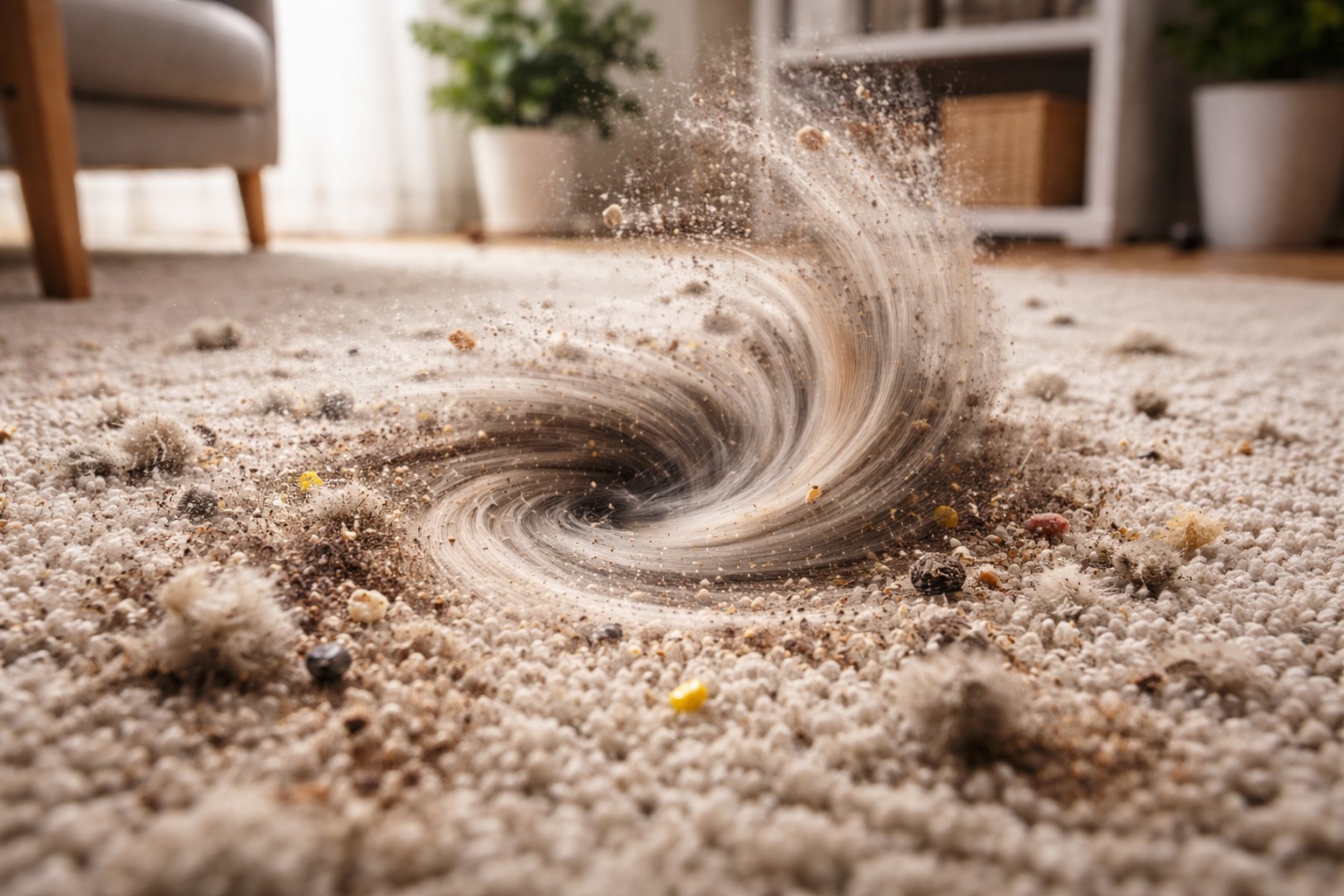
The main factor retaining particles is pile structure. A smooth floor allows dust to move freely from drafts, accumulating only in the corners. Carpeting, on the other hand, has a three-dimensional structure. Dust particles, falling between the fibers, get stuck in the “trap” and, under the influence of gravity, fall to the base. The thicker and higher the pile, the more difficult it is to remove dirt from it.
The second reason lies in the physics of materials. Most modern carpets are made of synthetics, which are excellent at accumulating static electricity. In the process of rubbing your feet against the surface, a charge is created that literally attracts microparticles from the air. In this case, the carpet works like an electromagnet, collecting everything that flies past, including pet hair and microplastics.
Also worth considering stickiness factor. In residential areas, the air often contains microscopic particles of grease (for example, from the kitchen) or moisture. When they settle on the fibers, they create an adhesive film. Ordinary dry dust, touching such a fiber, sticks tightly. This is why a simple vacuum cleaner does not always cope with the task, and the coating fades over time.
Another nuance is mechanical impact. When we walk on the carpet, we involuntarily trample down the dirt deeper. The pressure of the steps pushes the debris through the interweaving of threads to the substrate itself, where a dense, caked layer is created. It is almost impossible to remove it by surface cleaning, since the suction power of household appliances is lost in the thickness of the material.
Understanding these mechanisms allows you to realistically assess cleaning capabilities and select the right tools for caring for textiles in your home.
About the Author