
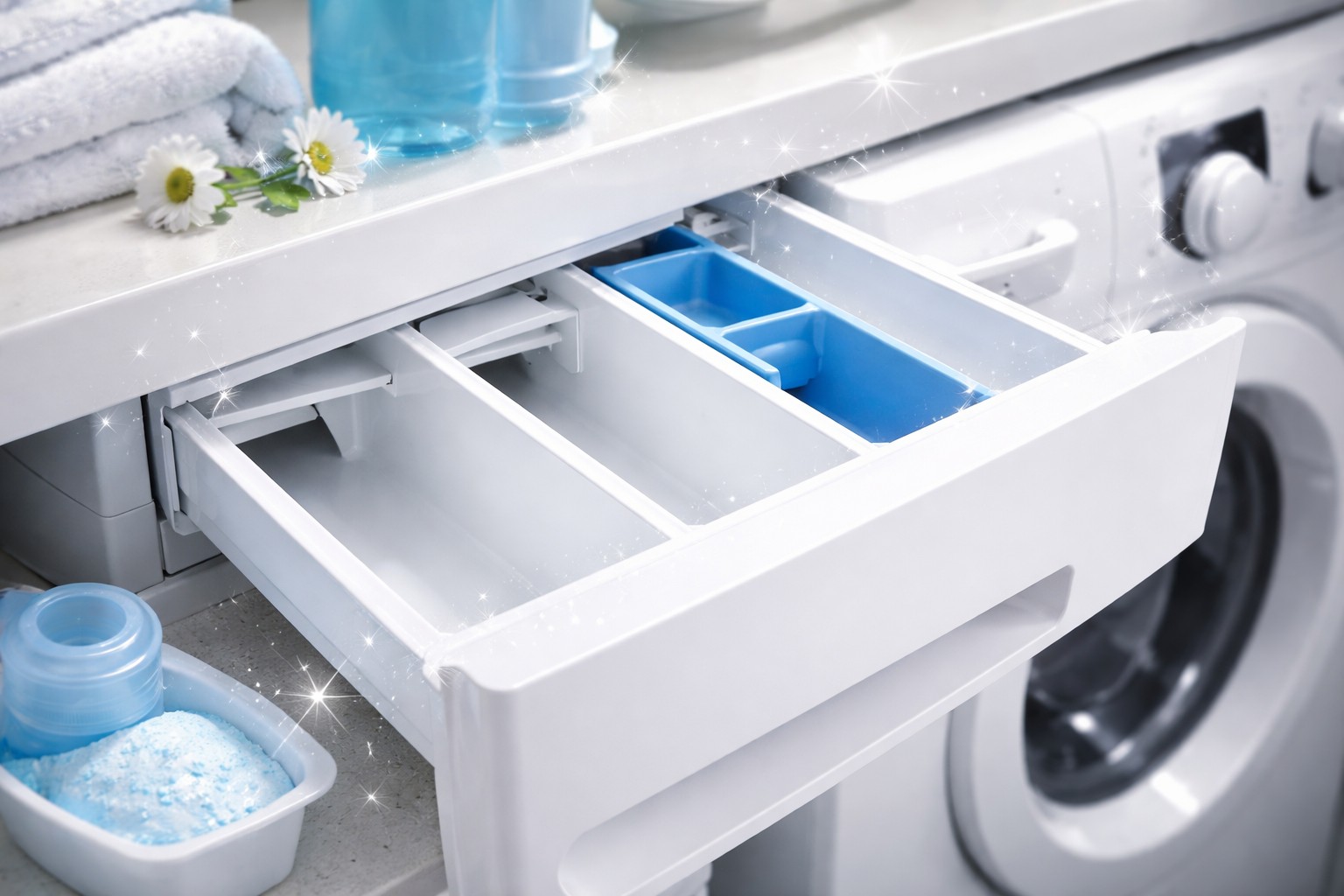
Many housewives are faced with a situation where washed clothes have an unpleasant musty smell, even though the wash has just finished. The reason often lies not in the drum or filter, but in powder receptacle. This is the wettest and darkest place in technology, where it instantly multiplies black mold and accumulates limescale. If you don’t clean this compartment, fungal spores end up on your clothes every time you wash them.
First you need to correctly remove the part. Most trays have a special retainer – usually this is a colored plastic insert in the middle (often blue) or a recess for the finger. Press this tab down and gently pull the tray towards you. Do not use brute force to avoid breaking the fragile plastic.
The easiest way to remove petrified powder and mold is by soaking. You don’t need expensive chemicals; home remedies will work great:
-
Take a bowl of hot water and dissolve 2 tablespoons of citric acid.
-
Place the tray in the solution until it is completely covered with water.
-
Leave the part to soak for 30–60 minutes to soften the coating.
-
For hard-to-reach corners, use an old one toothbrushit perfectly cleans dirt from narrow grooves.
While the tray is soaking, be sure to look inside the machine itself – into the niche where the container is inserted. Even more dirt and mucus often accumulates there. Arm yourself with a spray bottle of solution vinegar and water (1:1), spray the walls of the niche and wipe everything thoroughly with a rag. Pay special attention to the top holes through which water is supplied, as they can become clogged.
After the procedure, rinse the tray with clean water, wipe dry and put it back. To prevent mold from reoccurring, always leave the dishwasher slightly open to air out after each wash. A clean powder receptacle ensures that powder and conditioner enter the drum on time and in full.
About the Author