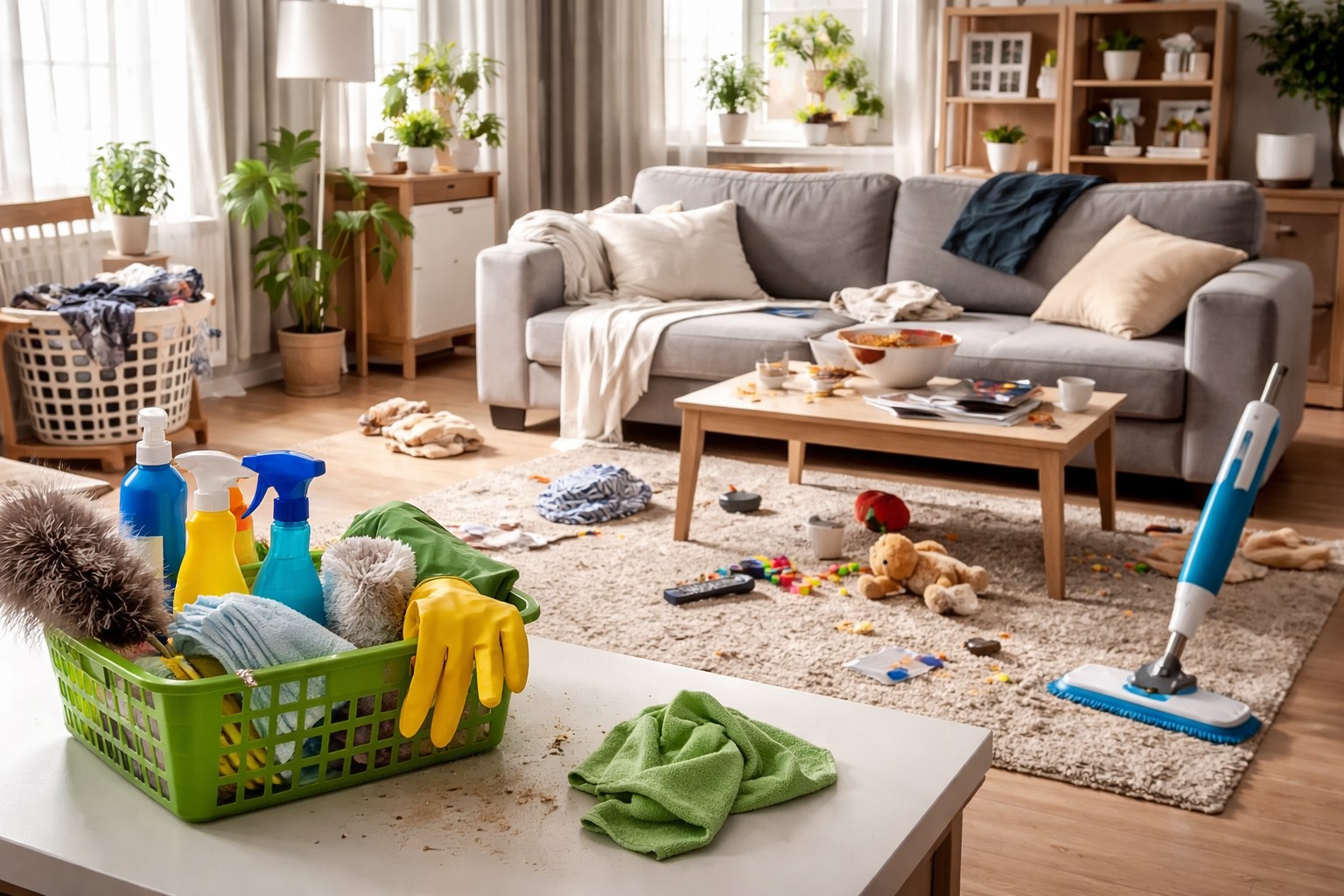
A familiar situation: you spent the whole weekend sorting through things, the apartment is sparkling clean, but by Wednesday a mountain of clothes has grown on the chair, and mugs and papers have accumulated on the table. The problem is not your laziness or lack of willpower. The reason lies in mistakes in organizing spacewhich provoke the emergence of chaos again and again. To break this vicious circle, you need to change not the cleaning process itself, but the approach to storing things.
Hot spot principle
There are places in every home that attract junk like a magnet. Usually this horizontal surfaces at waist level: bedside tables in the hallway, dining table or chest of drawers in the bedroom. We automatically put our keys, checks, mail or phone there because it’s convenient.
To solve the problem, you need to “break” the script. If small change always accumulates on your nightstand, put it there beautiful basket or tray. Confined clutter is no longer considered trash and becomes organized storage. Visual noise disappears when each group of objects has its own clear boundaries.
One touch rule
The main sponsor of chaos at home is the habit of postponing small actions “for later.” We think we’ll put the jacket in the closet later, but for now we’ll hang it on the back of the chair. This creates delayed decision effectwhich accumulates like a snowball.
Implement a simple rule: if an action takes less than a minute, do it immediately. Hanging a jacket on a hanger, throwing away a candy wrapper or putting the remote control back in place takes seconds. It is these micro-actions that prevent the formation of blockages, which then take hours to clear. Discipline is in the details saves your weekend.
Logistics of things
Often things are not returned to their places simply because their storage locations are inconveniently located. If you need to dismantle half of the closet to remove the vacuum cleaner, it will remain standing in the corner of the room.
The storage system should be intuitive. Essential items must be kept in arm’s length zone. Put things you rarely use on the top shelves. Test your apartment: if you have to make more than two extra movements to take or put down an item, it means organization system requires revision.
Incoming Flow Limit
It is impossible to maintain order if the number of things exceeds the physical capacity of your home. The cabinets are not rubber, and buying new organizers only temporarily masks the problem.
Use the one-in, one-out method. We bought new jeans – the old ones are sent for recycling or for sale. They brought a new magazine – the old one goes to waste paper. This tough but effective rule allows you to keep balance of things on the same level and do not clutter the space with unnecessary items that duplicate each other.
Consistency of small efforts always wins over chaotic attempts to do everything at once.
About the Author