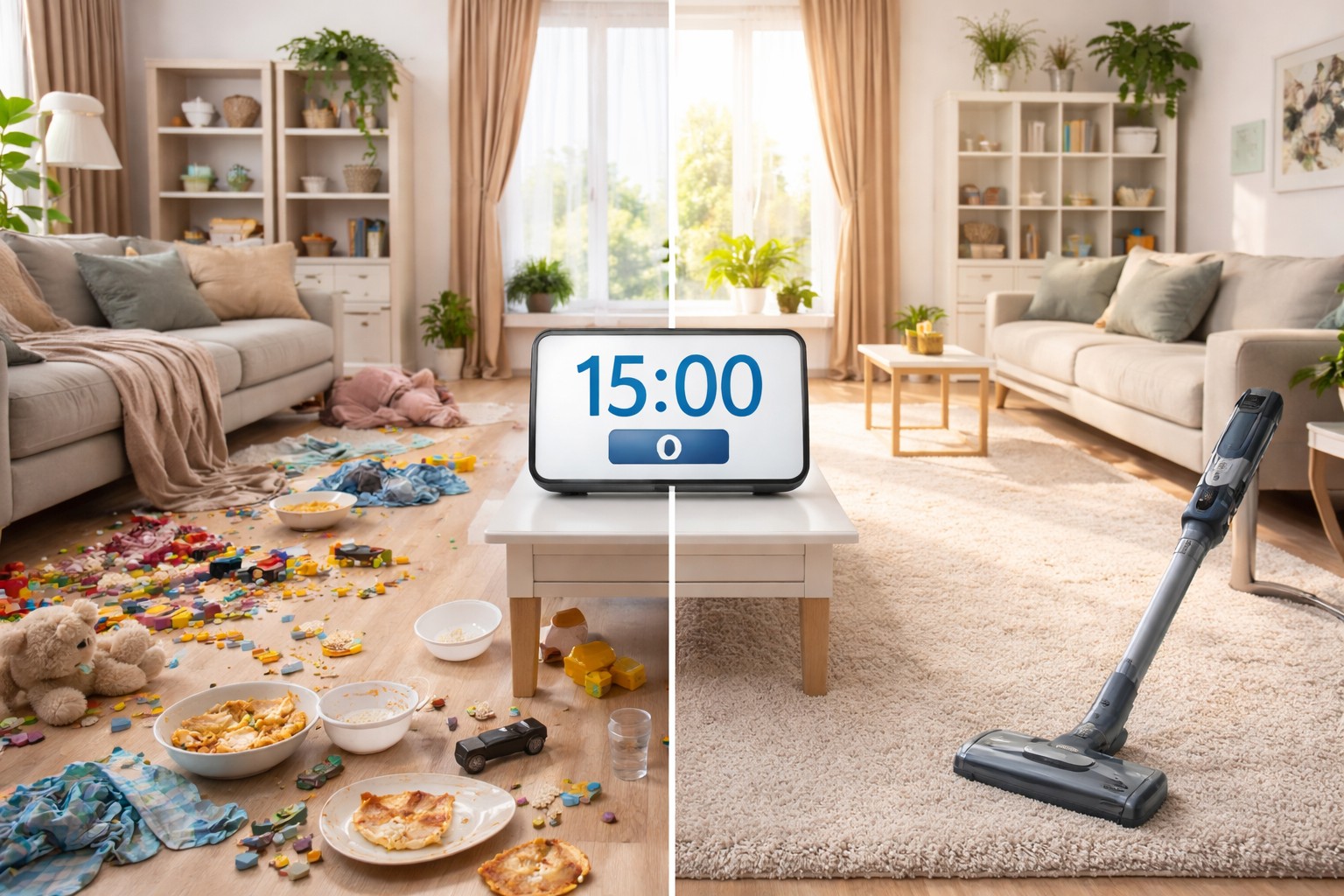
Many people perceive putting things in order as an endless process that takes up all their free time and energy. However, a simple tool such as timercan radically change the approach to household chores. Limiting time turns routine into a short sprint, increasing efficiency and reducing stress.
Psychological time trap
There is a famous observation called Parkinson’s law: work fills all the time allotted to it. If you decide to clean the room “until it’s clean,” the process may take the entire day. You will become distracted, spend too much time rubbing one spot, or move things around.
When you set a timer for 15 or 20 minutes, the brain switches to maximum concentration. A clear deadline forces you to act faster and more focused, cutting off unnecessary actions. Instead of lazily brushing away the dust, you begin to actively move, trying to catch the beep.
Victory over procrastination
The hardest part about cleaning is getting started. The thought that you will have to clear away the rubble for several hours causes internal resistance and a desire to postpone the task until later. The timer removes this psychological barrier.
Agreeing with yourself to work for just 10 minutes is much easier than deciding to do a spring cleaning. Often, after the timer rings, inertia appears, and the person continues cleaning of his own free will, but even if this does not happen, a short session is better than complete inaction.
Fighting perfectionism
Perfectionism is the enemy of cleanliness. The desire to do everything perfectly often leads to the fact that a person spends an hour dismantling one shelf, while the rest of the apartment remains in disarray. Time limits teach you how to allocate priorities.
In timer mode, you are forced to focus on what is truly important and noticeable. This helps maintain overall visual order, rather than going into details that no one will appreciate. This approach allows the house to look neat always, and not just on holidays.
Gamification element
Cleaning with a stopwatch adds an element to the routine excitement. The process turns into a competition with myself: how many things can I put away in 5 minutes? Will I have time to wash the dishes before the alarm goes off?
Gamification increases dopamine production when completing a task. The sound of the timer becomes a signal of a small victory, bringing a feeling of satisfaction instead of fatigue.
The timer method helps you form the healthy habit of cleaning regularly and little by little. This conserves energy and prevents burnout from household tasks, leaving your home clean without the exhausting effort.
About the Author