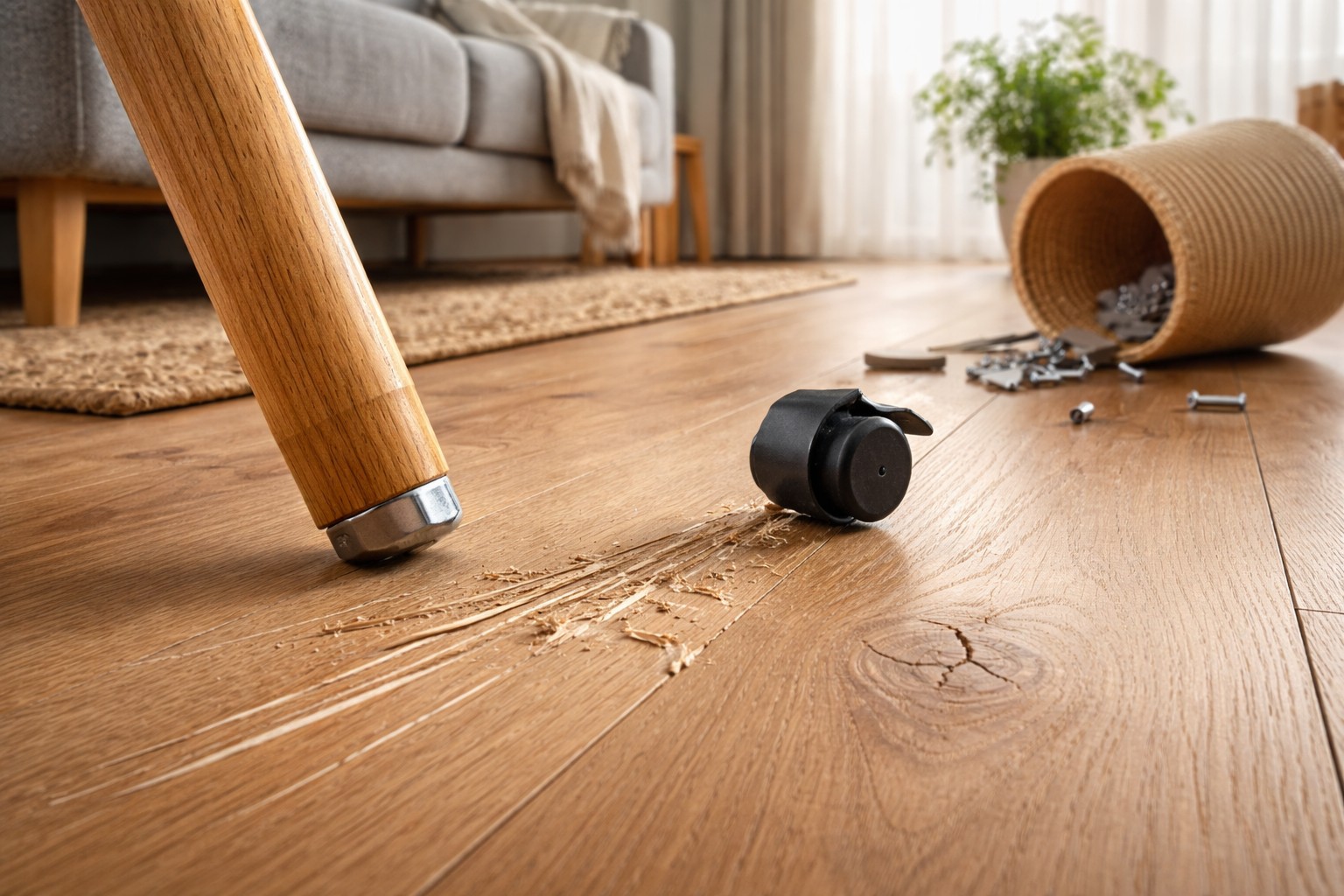
Even with careful treatment of the interior, apartment owners often notice laminate damage or parquet. It would seem that there are factory plugs on the legs or even special felt glued on, but the floor is still covered with a network of small defects. The problem lies not so much in the furniture itself, but in the non-obvious physical processes that occur under the weight of cabinets and sofas.
Sandpaper effect
The most common cause of damage is the accumulation of dirt. Soft felt padswhich are designed to protect the floor, over time turn into an abrasive tool. They are clogged into the porous structure of the material tiny grains of sandhouse dust and animal hair. When you move a chair or armchair even slightly, this accumulated layer acts as sandpaperleaving noticeable marks on the varnish or vinyl.
Factory tread problem
Many furniture manufacturers install standard plastic plugs. Often this plastic is too hard or has microscopic molding irregularities. Under the pressure of the weight of a person sitting on a chair, the hard plastic is literally pressed into the covering. If the floor is soft (for example, linoleum or cork), dents remain, and on hard surfaces, when moving, deep scratches.
Abrasion and exposure of fasteners
Any protection has its own service life. Over time, glued protectors flatten and move to the side, especially on furniture that is moved frequently. As a result, the leg begins to touch the floor with its edge or, worse, the adhesive layer is exposed. Frozen technical glue can be very hard and chemically aggressive to varnish. In the case of nailed overlays, the risk is even higher: when the head is washed, it comes out metal nailwhich can cause irreparable damage to the coating in one movement.
Cleaning mistakes
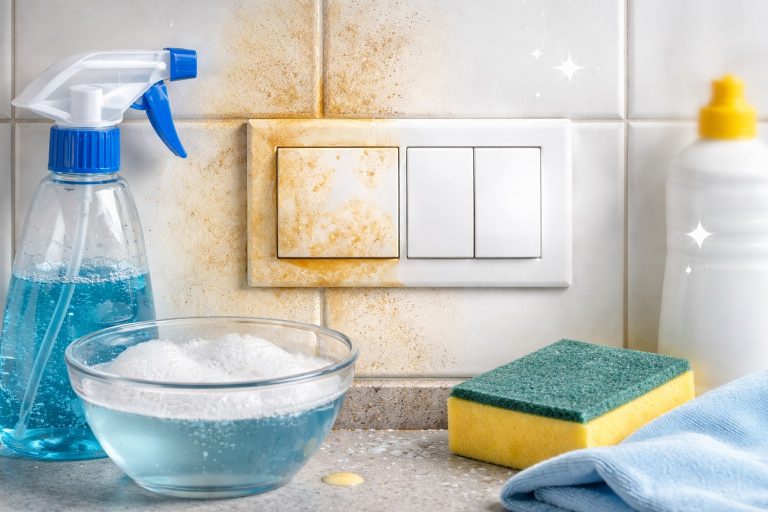
Sometimes scratches appear not because of the furniture itself, but because of improper cleaning of the floors around it. Water getting under the legs causes the wood to swell or the protective pads to become wet. A moist environment encourages solid particles to adhere to the base of the stem. When it subsequently dries, this dirt hardens and scratches the surface at the slightest movement of the object.
To maintain the integrity of the floor covering, it is necessary to regularly inspect the condition of the legs of chairs and tables, clean them of adhering debris and change protective stickers at the first signs of thinning.
About the Author