The sound of falling lids and the endless search for the right saucepan in the depths of the cabinet are familiar to many housewives. Improper organization of space in the kitchen not only wastes time, but also damages the dishes, shortening the life of the expensive non-stick coating. Competent storage of utensils allows you to free up work surfaces and make the cooking process much more enjoyable.
Vertical dividers and organizers
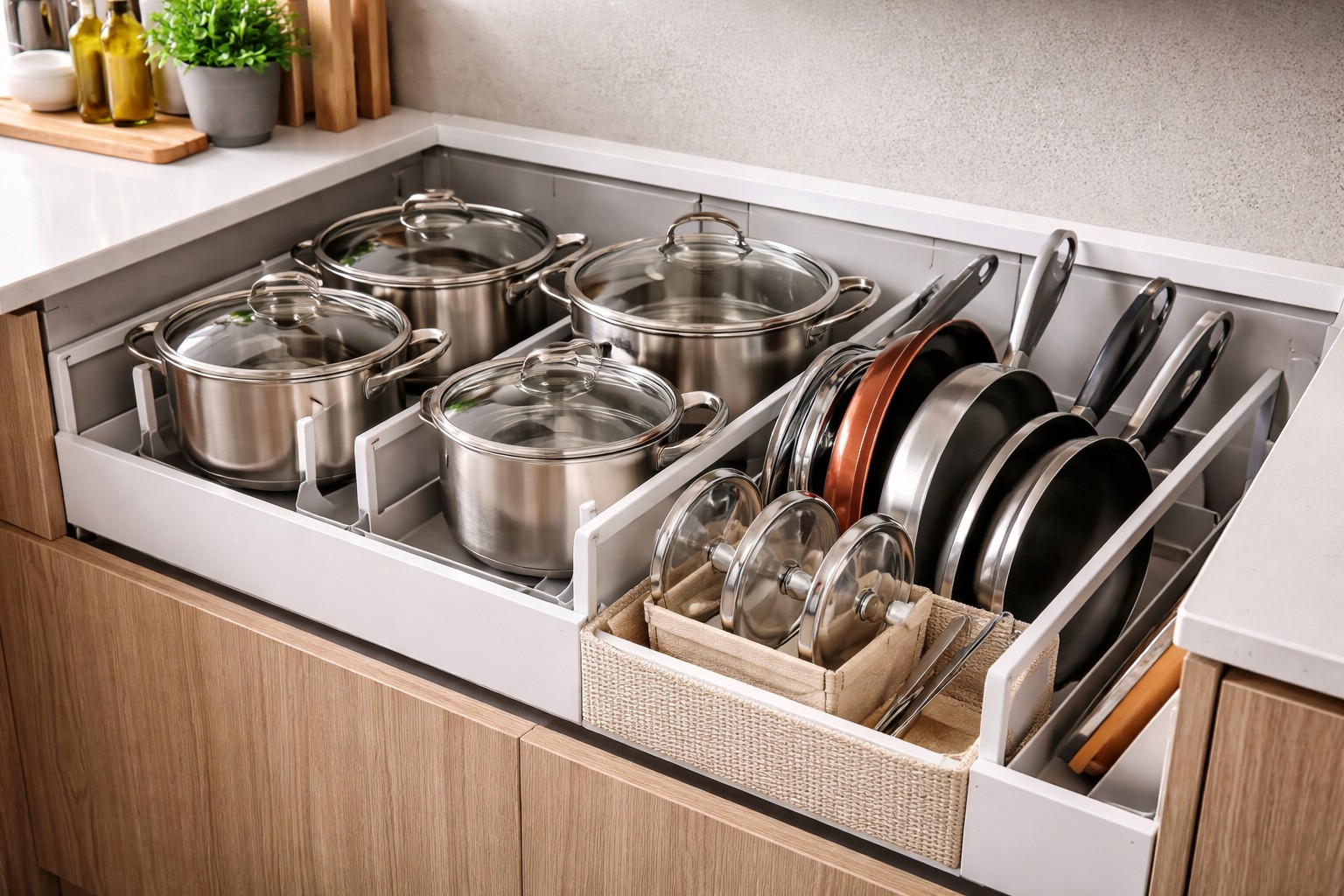
Stacking pans is the most obvious, but not the most practical method. To get the bottom one, you have to take out all the others. The solution will be special vertical stands. They resemble plate dryers, but have wider and stronger meshes.
This organizer can be placed directly in a deep drawer or on a closet shelf. Each frying pan or flat pan occupies its own cell without touching its neighbors. This guarantees safety of the coating and instant access to the desired item without unnecessary fuss.
Using the inside of doors
The space on kitchen cabinet doors is often empty, although it is an ideal place for flat items. This is the most convenient place to organize storage of lids. There are special narrow holders that are attached to self-tapping screws or double-sided tape.
You can also install on the doors hooks for light pans or ladles. This will relieve the main shelves and allow you to use the “dead zones” of the headset. The main thing is to make sure that the door hardware will support the additional weight, and that items will not hit the shelves when closed.
Retractable systems and corner carousels
Deep corner cabinets often turn into a “black hole” where rarely used dishes disappear. Ideal for such areas pull-out baskets and “magic corner” type systems. They allow you to smoothly pull all the contents out, providing a complete overview.
Rotating carousels for pots – another way to optimize. You simply turn the shelf around its axis and take the desired container. This is especially true for heavy cast iron cauldrons and large pans that are inconvenient to move from place to place.
Railings and wall storage
If there is a catastrophic lack of space in the cabinets, it is worth moving some of the dishes to the walls. Open storage at roof rails with hooks – a popular technique in professional kitchens. This is convenient, since everything is at arm’s length.
To make the interior look neat, it is better to hang in plain sight only those dishes that have an aesthetic appearance and are often used. Copper sauté pans or stylish black frying pans can become… decor accent. It is important to remember that when stored open, dishes become covered with dust faster, so this option is only suitable for actively used utensils.
The principle of matryoshka with protection
Sometimes stacking dishes one inside the other is the only solution for a small kitchen. To avoid scratching the bottom and walls, you must use soft pads.
You can buy them at hardware stores (usually made from felt or silicone) or cut them yourself from thick fabric. This layer creates shock absorption and protects brittle coating pans from chipping.
Perforated panels
Pegboards, or pegboards, have made their way from garages to modern kitchens. This is a panel with many holes into which pegs and hooks are inserted in random order. You can change the configuration storage systems at any time, adjusting it to new purchases.
This board looks great on a spare wall or even inside a pantry. It allows you to place pots, colanders and frying pans of any diameter without being tied to standard shelf sizes.
Proper organization of kitchen utensils is a matter not only of aesthetics, but also of ergonomics, because easy access to tools significantly speeds up cooking and makes cleaning easier.
About the Author