Small trash is technogenic paradoxwhich turns ordinary cleaning into an endless process. While large objects are easy to spot and eliminate, tiny particles have the amazing ability to “dissolve” into space while remaining physically present. The problem is not only aesthetics, but also physical properties materials that make up modern litter.
Static electricity and the laws of physics
One of the main reasons why small pieces of plastic, foam or synthetic fibers are so difficult to collect is static charge. When you try to brush them off, the particles do not move into the dustpan, but “stick” to the pile or scatter in different directions.
-
Electrostatics causes dust to adhere to vertical surfaces and clog into the smallest crevices.
-
Light weight particles allows them to move even from the weak air flow created by the movement of the broom.
-
Friction during cleaning it only strengthens the attraction, creating a vicious circle.
Adhesion and structural traps
Surfaces in our homes and streets are rarely perfectly smooth. At the microscopic level, even laminate or tile have microcracks and pores.
-
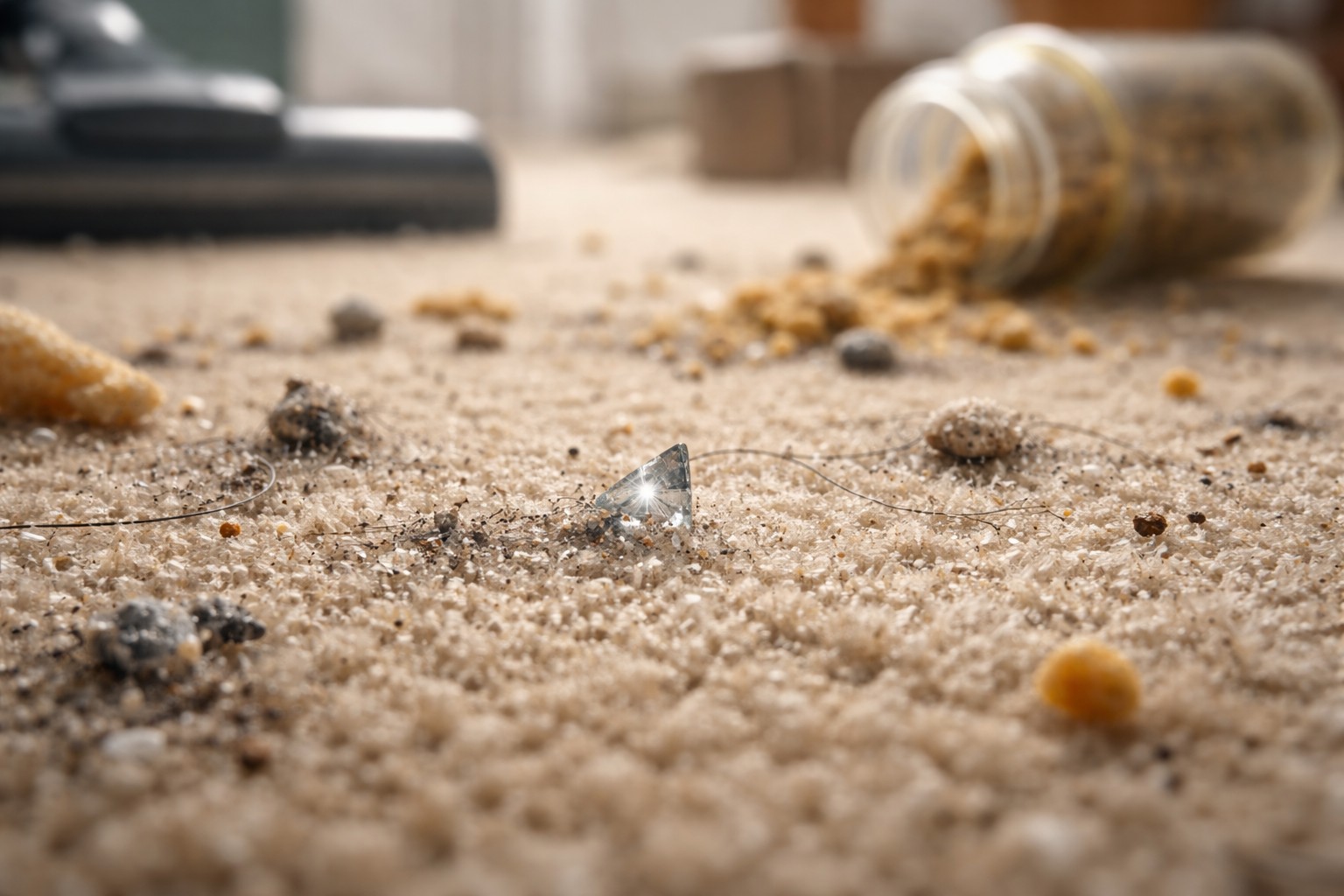
Microplastic and the crumbs fall into the structure of the carpet, where they are retained by the pile as a natural filter.
-
Humidity turns ordinary dust into a sticky substance that literally sticks to the coating, requiring chemical action instead of simple mechanical action.
-
Complex geometry corners, baseboards and furniture joints creates “blind spots” that are inaccessible to standard cleaning tools.
Psychology of perception and visual noise
The difficulty of cleaning small debris is also associated with the peculiarities of human vision. We tend to ignore objects below a certain size threshold until their concentration becomes critical. Visual noise a variegated carpet or textured floor masks specks, which leads to their gradual accumulation. As a result, when contamination becomes obvious, it is already a dense layer, deeply embedded in the surface.
Effective control of such pollution requires the use of HEPA filtersspecialized nozzles with soft bristles and products with an antistatic effect. Conventional methods often only redistribute small particles throughout the room, lifting them into the air and allowing them to settle in new places. The constant circulation of microparticles in a confined space makes the process of cleaning the environment a labor-intensive and technologically complex task.
About the Author